Convoys · Compliance and Assurance · NCA ECC
NCA Essential Cybersecurity Controls, ECC-2:2024. Experimental
Available now, in the experimental Convoy. Saudi Arabia. Regulator: National Cybersecurity Authority (NCA).
The convoy's first regime. It holds every requirement of the Saudi National Cybersecurity Authority's Essential Cybersecurity Controls under NCA's own identifiers, enforces and checks those a Kubernetes cluster can show, and lists the rest as your organisation's evidence, in a dated report every day.
This regime is available in the Compliance and Assurance Convoy, which is experimental. The screenshots on this page are taken on a test cluster with sample workloads.
Who it applies to
Government entities and critical national infrastructure in Saudi Arabia.
The Essential Cybersecurity Controls are issued by the National Cybersecurity Authority of Saudi Arabia. They bind government agencies and their affiliated companies and entities, inside and outside the Kingdom, and private-sector organisations that own, operate or host critical national infrastructure; NCA encourages other organisations to apply them. NCA assesses compliance through self-assessment, its assessment and compliance tool, and field audits.
ECC-2:2024 replaced ECC-1:2018. NCA publishes it openly, and its Arabic text is the binding one.
Structure and evidence
Four domains, 176 requirements, each with exactly one result.
The convoy holds all 176 requirements of ECC-2:2024, across its four domains and 28 subdomains, under NCA's own identifiers, with a short description of what each asks written by Mamluk; NCA's text is not reproduced, and the authoritative wording remains NCA's publication. Each requirement is classed by how its evidence is obtained:
| Domain | Enforced | Checked | Platform | Your evidence | Total |
|---|---|---|---|---|---|
| 1 Governance | 1 | 3 | 0 | 46 | 50 |
| 2 Defence | 6 | 11 | 13 | 78 | 108 |
| 3 Resilience | 0 | 0 | 0 | 6 | 6 |
| 4 Third parties and cloud computing | 0 | 0 | 0 | 12 | 12 |
| All requirements | 7 | 14 | 13 | 142 | 176 |
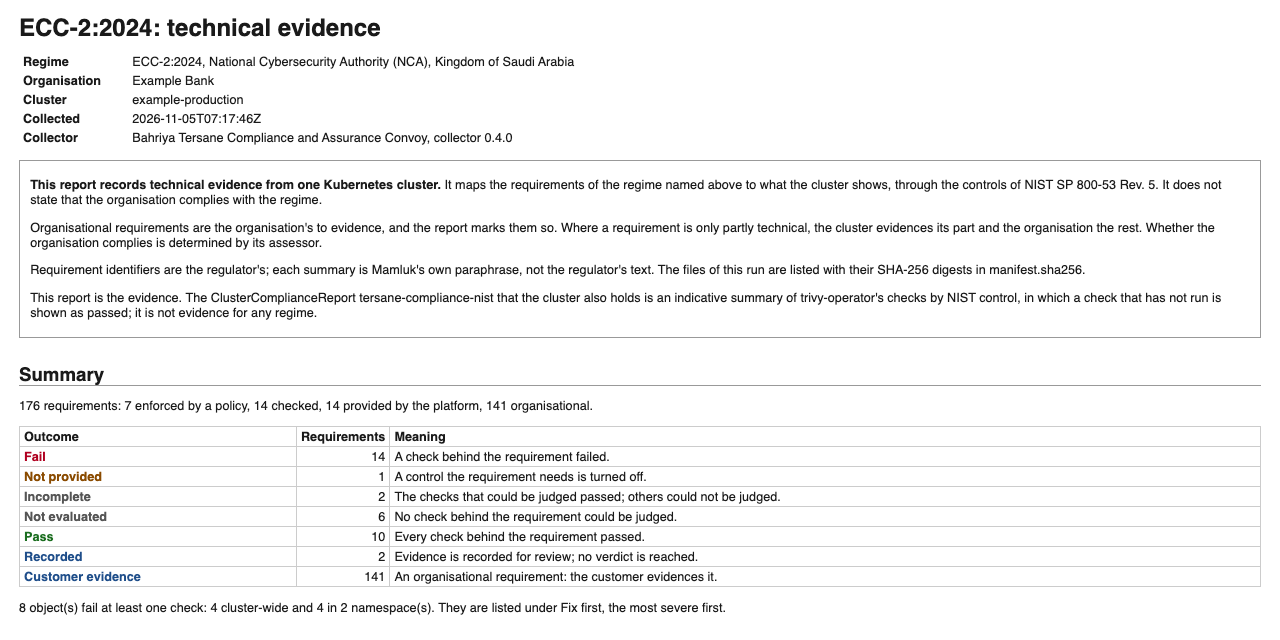
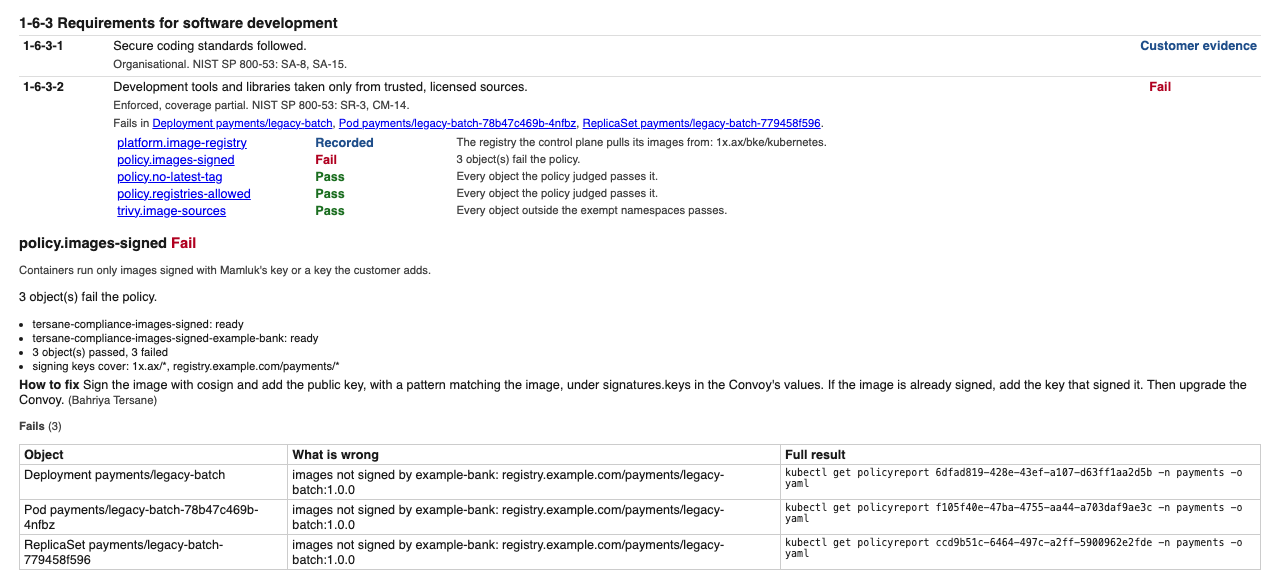
- Enforced (7). An admission policy of the convoy flags, and once you choose blocks, what the requirement forbids: software only from trusted sources (1-6-3-2), asset classification labels (2-1-5), network segmentation and the separation of production from test and development (2-5-3-1, 2-5-3-2), restricted network services (2-5-3-5), and secure protocols for external web applications (2-15-2, 2-15-3-3). The report shows the policy's result for every object it applies to.
- Checked (14). The convoy observes the requirement in the cluster and reports it: vulnerability assessment, classification by severity and remediation (2-10), patching (2-3-3-3), least privilege, privileged access and access review (2-2-3-3 to 2-2-3-5), the asset inventory (2-1-2), the network security requirements in effect (2-5-2), and vulnerabilities and secure configuration reviewed before launch (1-6-2-1, 1-6-2-2, 1-6-3-5).
- Platform (13). The platform provides the control and the convoy reports it: identity and authentication for access to the cluster (2-2-2 to 2-2-3-2), the protection of the systems themselves (2-3-2), a trusted time source (2-3-3-4), encryption in transit, the encryption of Kubernetes Secrets at rest and the key that protects them (2-8), and audit logging, including privileged access, kept for the twelve months 2-12-3-5 requires (2-12). BKE declares these facts from 2.3.0; on earlier BKE versions and on other distributions, these requirements are reported as not evidenced by the cluster, and the report asks for your evidence of them.
- Your evidence (142). Strategy, governance, risk, awareness, human resources, physical security, the protection of data by its classification, resilience and third parties are your organisation's to evidence. The report lists each one as customer evidence, so the record of the regime is complete and nothing is presented as covered that is not.
Thirty-three of the 34 technical requirements are partly technical: the cluster evidences its own part, and the report also asks for your evidence of the rest, for example the documented procedure behind a vulnerability management requirement. Where a regime sets a threshold, the convoy uses the regime's value: ECC's twelve months of event log retention is the value the audit log rotation check is judged against.
The report
In NCA's numbering, from the cluster itself.
Each run writes the report in HTML and PDF, with OSCAL assessment results and a signed manifest, to a volume in your cluster, and delivers it to the email addresses and storage you configure. Each image opens at full size when selected.
The mapping
Mamluk's mapping, keyed to NIST.
Each requirement is mapped to the NIST SP 800-53 Rev. 5 controls it corresponds to, and each NIST control to the checks that evidence it in the cluster. The checks and their NIST mapping are shared by every regime, so a cluster is scanned once and each regime selected is reported from the same evidence, in its regulator's own numbering.
NCA's requirements are mapped to NIST by Mamluk, requirement by requirement; the mapping and the classes on this page are Mamluk's reading of ECC-2:2024, and the authoritative wording remains NCA's publication.
The mapping is Mamluk's, and the report says so. It records the technical evidence the cluster provides; it does not make an organisation compliant, and compliance is determined by your assessor.
Regimes
One convoy, every regime.
Every regime runs in the same installation of the convoy. An organisation that answers to two regulators selects both, and each is licensed separately. The convoy is experimental; the regimes not yet available are coming soon.
- NCA Essential Cybersecurity Controls, ECC-2:2024 (Saudi Arabia). Available.
- Qatar Central Bank, Technology Risks (Qatar). Expected Q1 2027.
- SAMA Cyber Security Framework (Saudi Arabia). Expected Q1 2027.
- UAE Information Assurance Standard v2.1, with the Central Bank of the UAE's requirements for banks (United Arab Emirates). Expected Q1 2027.
- SAMA Cyber Resilience Fundamental Requirements, for new and sandbox financial entities (Saudi Arabia). Expected Q3 2027.
- Central Bank of Bahrain Rulebook, module OM-5.5, for conventional and Islamic banks (Bahrain). Expected Q3 2027.
- National Information Assurance Standard (Qatar). Expected Q4 2027.
- Central Bank of Kuwait Cyber and Operational Resilience Framework (Kuwait). Expected Q4 2027.
Price and availability
Each regime is licensed at USD 24,000 per organisation, per year, with the Tersane core licence; there is no base fee. The convoy needs Kubernetes 1.36 or later, which BKE provides from 2.2.0. See the Compliance and Assurance Convoy for how it works, and its documentation for installation.
Discuss NCA ECC
To discuss the regimes your organisation must meet, or the convoy's licensing, contact Mamluk.
Contact Mamluk