Convoys · Compliance and Assurance · CBUAE
Central Bank of the UAE: operational risk management. Coming soon
Expected Q1 2027. United Arab Emirates. Regulator: Central Bank of the UAE (CBUAE).
The convoy's regime for banks and other institutions the Central Bank of the UAE licenses. It will map the requirements of the Central Bank's Operational Risk Management Regulation on ICT and cybersecurity, incidents and change to the evidence a Kubernetes cluster can show, in the Central Bank's own numbering.
This regime is in preparation. The structure below is taken from the Central Bank's regulation; how each requirement will be evidenced is planned, and is confirmed when the regime is released.
In brief
Who sets these requirements, and how the convoy evidences them.
Central Bank of the UAE (CBUAE). The CBUAE licenses and regulates banks and other financial institutions in the United Arab Emirates. Its Operational Risk Management Regulation sets their requirements for information and communications technology and cybersecurity, and requires them to comply with the cybersecurity regulations of the other UAE authorities.
UAE Information Assurance Standard (UAE IA). The Information Assurance Standard is the UAE's federal standard of security controls, binding on federal government entities and on critical information infrastructure, banks among them. Version 2.1 holds 134 controls in fifteen families, and maps each control to NIST SP 800-53 itself.
The convoy classes each requirement by how its evidence is obtained: enforced by an admission policy, checked in the cluster, provided by the platform, or the organisation's own evidence. An admission policy is a rule Kubernetes applies to each object as it is created or changed, before the object is stored. It can warn about the object and record the result, or refuse the object. How a regulator's requirement becomes evidence follows one requirement from the regulator's text to the result in the report.
Who it applies to
Banks and other institutions the Central Bank licenses.
The Central Bank of the United Arab Emirates sets its requirements for the institutions it licenses, banks among them, in its Operational Risk Management Regulation, in force since September 2026. Its article on information and communications technology (ICT) and cybersecurity asks for a board-approved framework, regular testing of controls, a plan to retire unsupported systems, the master system of record kept in the UAE, and compliance with the cybersecurity regulations of the other UAE authorities.
One of those is the UAE Information Assurance Standard, a regime of its own, licensed separately and reported in its own numbering; this regime does not repeat it. With both selected, the convoy scans the cluster once.
Structure
Three articles, and the clauses they draw on.
The regime covers the regulation's articles on ICT and cybersecurity, incident management and change management in full, and the clauses of other articles they draw on: 63 requirements in the Central Bank's own numbering. The regulation's other clauses, among them those on the duties of the board and senior management for ICT risk, are outside it.
Evidence, as planned
What the cluster will show, and what remains the bank's.
- Checked in the cluster (planned). Five of the 63 requirements, among them the retirement of unsupported software, judged from the support periods of the cluster's Kubernetes release and of each image's operating system.
- The bank's evidence (planned). The other 58, such as the board-approved framework, incident notification and the testing of controls, are the bank's to evidence, and the report will list each as such.
The mapping
Mamluk's mapping, keyed to NIST.
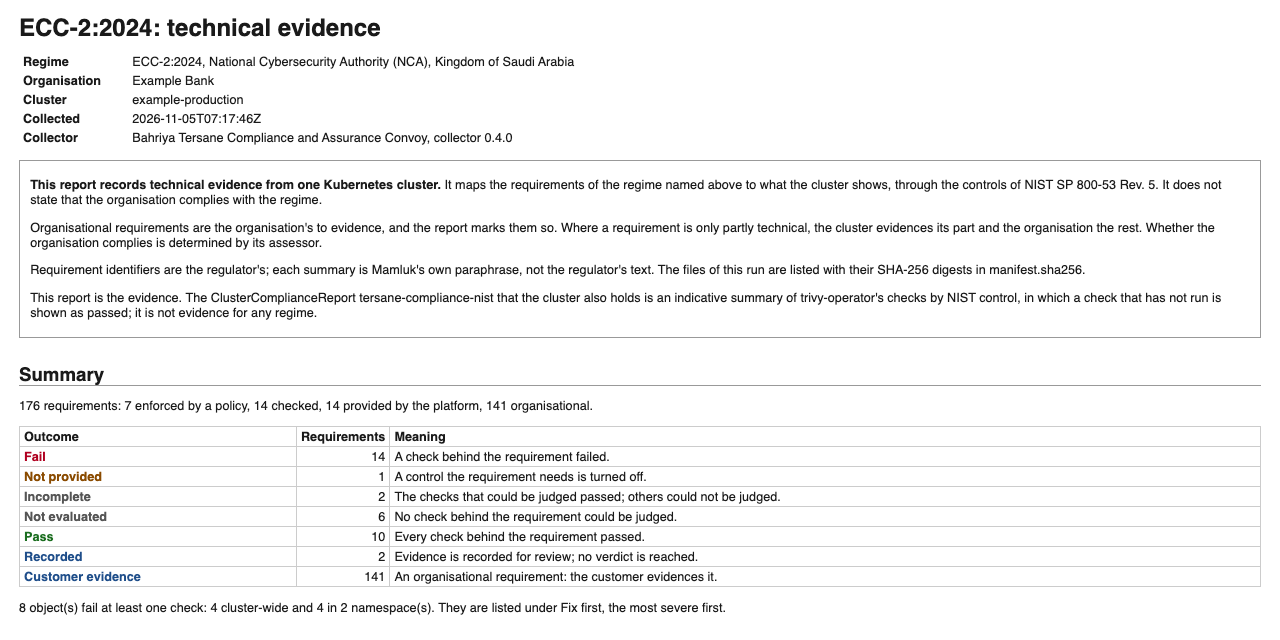
Each requirement is mapped to the controls of NIST Special Publication 800-53, Revision 5 (SP 800-53), published by the National Institute of Standards and Technology (NIST), and each NIST control to the checks that evidence it in the cluster. NIST is the United States government's standards agency. Its security publications are free to use, and regulators and auditors outside the United States also use them as a common reference. SP 800-53 is a control catalogue: a numbered list of safeguards, each stating one thing an organisation should do, such as AC-6, least privilege, or AU-11, keeping audit records for a set period. Its controls are grouped in 20 families, and because the catalogue is detailed and open, it serves as a common language between regulations that are each written in their own terms.
The checks and their NIST mapping are shared by every regime, so a cluster is scanned once and each regime selected is reported from the same evidence, in its regulator's own numbering.
The Central Bank publishes no mapping of its regulation's requirements to NIST SP 800-53 or to any other catalogue.
The regulator publishes no official crosswalk to NIST, so the mapping is Mamluk's own. Before the regime is released, it is checked against the regulator's text a second time, by a reviewer other than its author.
The report states whose mapping it uses, in these words: “The Central Bank publishes no mapping of this regulation to NIST SP 800-53. The mapping in this report is Mamluk's own.” It records the technical evidence the cluster provides; it does not make an organisation compliant, and compliance is determined by your assessor.
Regimes
One convoy, every regime.
Every regime runs in the same installation of the convoy. An organisation that answers to two regulators selects both, and each is licensed separately. The regimes not yet available are coming soon.
- NCA Essential Cybersecurity Controls, ECC-2:2024 (Saudi Arabia). Available.
- Qatar Central Bank, Technology Risks (Qatar). Available.
- SAMA Cyber Security Framework (Saudi Arabia). Expected Q1 2027.
- UAE Information Assurance Standard v2.1 (United Arab Emirates). Available.
- Central Bank of the UAE, Operational Risk Management Regulation, for banks (United Arab Emirates). Expected Q1 2027.
- SAMA Cyber Resilience Fundamental Requirements, for new and sandbox financial entities (Saudi Arabia). Expected Q3 2027.
- Central Bank of Bahrain Rulebook, module OM-5.5, for conventional and Islamic banks (Bahrain). Expected Q3 2027.
- National Information Assurance Standard (Qatar). Expected Q4 2027.
- Central Bank of Kuwait Cyber and Operational Resilience Framework (Kuwait). Expected Q4 2027.
Glossary
The organisations, standards and tools the convoy's pages name.
- NIST National Institute of Standards and Technology
- NIST is the United States government's standards agency. Its security publications are free to use, and regulators and auditors outside the United States also use them as a common reference.
- SP 800-53 NIST Special Publication 800-53, Revision 5
- SP 800-53 is a control catalogue: a numbered list of safeguards, each stating one thing an organisation should do, such as AC-6, least privilege, or AU-11, keeping audit records for a set period. Its controls are grouped in 20 families, and because the catalogue is detailed and open, it serves as a common language between regulations that are each written in their own terms.
- NCA National Cybersecurity Authority
- NCA is Saudi Arabia's national authority for cybersecurity. It sets the cybersecurity requirements for government entities and the operators of critical national infrastructure, and assesses compliance with them.
- ECC Essential Cybersecurity Controls
- The ECC are NCA's minimum cybersecurity requirements, binding on government entities and critical national infrastructure in Saudi Arabia. The current edition, ECC-2:2024, holds 176 requirements in four domains.
- SAMA Saudi Central Bank
- SAMA regulates banks, insurers, financing companies and other financial institutions in Saudi Arabia. It keeps the abbreviation of its former name, the Saudi Arabian Monetary Authority.
- SAMA CSF SAMA Cyber Security Framework
- The Cyber Security Framework sets the cybersecurity requirements for the organisations SAMA regulates, as control considerations in four domains. It is distinct from NIST's Cybersecurity Framework, which is also abbreviated CSF.
- QCB Qatar Central Bank
- QCB is Qatar's central bank and the regulator of its banks. Its circular on technology risks, issued in January 2018, sets the technology and cybersecurity requirements for the banks it regulates, in 516 numbered statements.
- CBUAE Central Bank of the UAE
- The CBUAE licenses and regulates banks and other financial institutions in the United Arab Emirates. Its Operational Risk Management Regulation sets their requirements for information and communications technology and cybersecurity, and requires them to comply with the cybersecurity regulations of the other UAE authorities.
- UAE CSC UAE Cyber Security Council
- The Cyber Security Council is the federal authority for cybersecurity in the United Arab Emirates, and issues the UAE Information Assurance Standard.
- UAE IA UAE Information Assurance Standard
- The Information Assurance Standard is the UAE's federal standard of security controls, binding on federal government entities and on critical information infrastructure, banks among them. Version 2.1 holds 134 controls in fifteen families, and maps each control to NIST SP 800-53 itself.
- GCC Gulf Cooperation Council
- The GCC's six member states are Saudi Arabia, the United Arab Emirates, Qatar, Kuwait, Bahrain and Oman.
- namespace
- A namespace is a named partition of a Kubernetes cluster, which usually holds one application's or one team's workloads. Permissions and policies are commonly set per namespace.
- admission policy
- An admission policy is a rule Kubernetes applies to each object as it is created or changed, before the object is stored. It can warn about the object and record the result, or refuse the object.
- Kyverno
- Kyverno is an open-source policy engine for Kubernetes. The convoy uses it for what Kubernetes cannot do by itself, such as verifying an image's signature, and reads the results of its own policies from Kyverno's policy reports.
- trivy-operator
- trivy-operator is an open-source security scanner that runs inside the cluster. It scans every workload's images for known vulnerabilities, and audits each workload's configuration and the permissions granted in the cluster.
- NetworkPolicy
- A NetworkPolicy is the Kubernetes object that states which network traffic may reach a group of workloads. A workload that no NetworkPolicy selects accepts traffic from anywhere in the cluster.
- Pod Security Kubernetes Pod Security Standards
- The Pod Security Standards are three built-in levels, privileged, baseline and restricted, of what a workload may do to the server it runs on, such as running as root or reading the server's own files. Kubernetes enforces the level set for each namespace.
- OSCAL Open Security Controls Assessment Language
- OSCAL is NIST's machine-readable format for control catalogues and assessment results. Governance, risk and compliance tools import results in it, so findings need not be typed in again.
- NSA and CISA National Security Agency and Cybersecurity and Infrastructure Security Agency
- The two United States agencies publish joint guidance on hardening Kubernetes, which the convoy's checks also follow.
Price and availability
Each regime is licensed at USD 24,000 per organisation, per year, with the Tersane core licence; there is no base fee. The convoy needs a version of Kubernetes which BKE provides; the prerequisites give the requirement. See the Compliance and Assurance Convoy for how it works, and its documentation for installation. Activating a regime describes how a regime is added to the licence and to a running installation. Its reports can be read in your own cluster, by role, in the Compliance App.
Discuss CBUAE
To discuss the regimes your organisation must meet, or the convoy's licensing, contact Mamluk.
Contact Mamluk